
Meet Tad Bassett, Wildlife Biologist & Owner
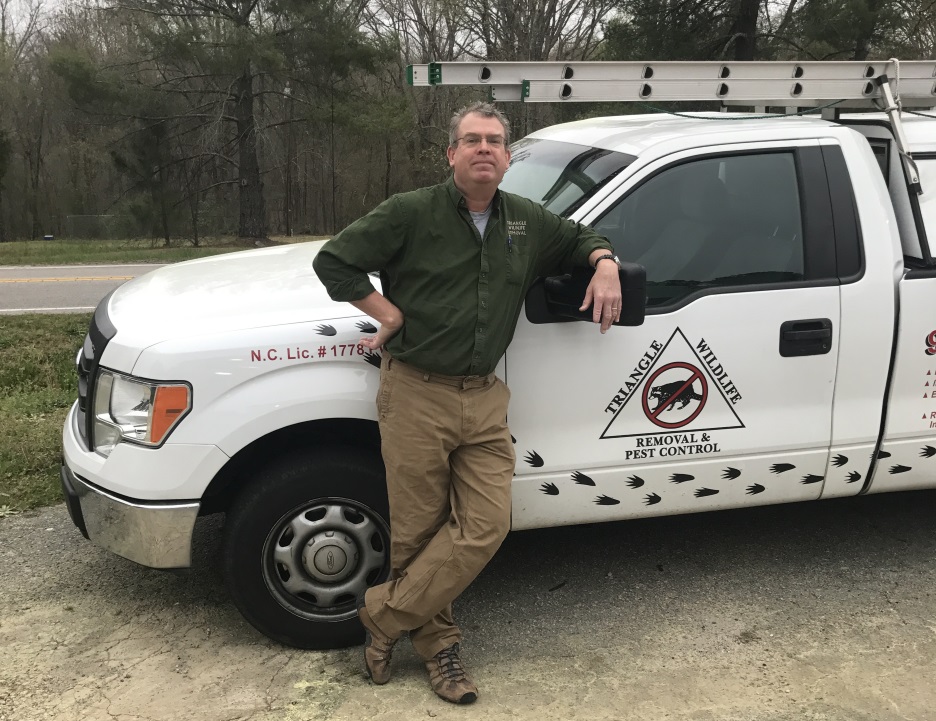
Owner/President: Tad Bassett
- Legal Name: Earl Clarence Bassett IV
- Professional Name: Tad Bassett
- Date of Birth: August 27, 1965
- Title: Owner/President and On-Staff Wildlife Biologist
- Professional Membership: National Wildlife Control Operators Association (NWCOA)
Education
- B.S. in Fisheries and Wildlife Management: North Carolina State University, 1990
- Wildlife Management Studies: Unity College, Unity, Maine, 1985 (transferred to NC State)
- Tad’s educational background qualifies him as a Wildlife Biologist, and he serves in that capacity for the company.
State and Industry Credentials
Tad Bassett has spent 36 years solving wildlife problems across the Triangle and Eastern North Carolina. He founded Triangle Wildlife Removal in 1990 and has been running it full-time since January 1996, making it Raleigh’s longest-operating wildlife removal company. He holds a Bachelor of Science in Fisheries and Wildlife Management from NC State University, is a member of the National Wildlife Control Operators Association (NWCOA), carries both a NC Wildlife Control Agent permit (#DCA25000312) and a state pest control license (#1778 PW), and still answers the phone himself after all these years.
Growing Up Around Wildlife
Tad’s connection to wildlife started early. Growing up in Mobile, Alabama and Panama City, Florida, his father taught him and his siblings about the animals and natural world around them. When the family moved to Edenton, North Carolina in the late 1970s, the rural landscape opened up a whole new world. Fishing, camping, hunting, trapping – the kind of hands-on outdoor education you can’t get from a textbook.
That upbringing shaped everything that followed. Right out of high school, Tad landed a position with the NC Wildlife Resources Commission as a full-time temporary technician in Edenton. He worked on the Canada goose relocation program and helped manage state Game Lands. It was grunt work and field work and long days outside, and he loved every minute of it.
From the Field to the Classroom and Back Again
In 1985, Tad enrolled at Unity College in Unity, Maine to study Wildlife Management. While in Maine, he interned with the Maine Inland Fisheries and Wildlife department, where he captured, sexed, marked, and released Landlocked Salmon (Salmo salar) across various lakes throughout the state. The research focused on population dynamics, and it gave him firsthand experience with the scientific side of wildlife management that most people in this industry never get.
He transferred to NC State University and graduated in 1990 with a Bachelor of Science in Fisheries and Wildlife Management. That degree makes him a Wildlife Biologist by training, and he still serves in that capacity for the company today. Between semesters, he returned to the NC Wildlife Resources Commission as a technician, keeping one foot in the field even while finishing his education.
The Decision to Go Independent
After graduating from NC State, Tad had options. The NC Wildlife Resources Commission offered him a position in the Sandhills region, but by that time he was already working in management at United Parcel Service, where he had been since 1985. UPS was paying double what the state was offering with benefits that matched, so leaving didn’t make financial sense.
He also explored the franchise route. In 1990, he interviewed with Critter Control and met with Kevin Clark at their headquarters in Michigan. But the franchise model and the way they approached the business didn’t sit right with him. Tad wanted to do things his own way.
So he built it from scratch. While working evenings at UPS, he used his free daytime hours to start Triangle Wildlife Removal on a part-time basis. No franchise fees, no corporate playbook. He went door to door with business cards, building relationships with animal control officers, veterinarians, health departments, police departments, and sheriff’s offices across the Triangle. Word spread because the work was good.
Going All In
After a couple of years of running both careers, Tad was promoted to full-time management at UPS. The role came with serious responsibility – 110 employees and 15 supervisors reporting to him. For five years, he gave it everything he had. But the whole time, he knew where he really wanted to be.
In January 1996, he made the call. He left UPS and went full-time with Triangle Wildlife Removal. A decade of managing a large workforce at one of the biggest logistics companies in the world had taught him how to run operations, lead people, and build systems. He brought all of that into the wildlife business.
Shortly after going full-time, he also launched a Crime Scene Clean-Up division, handling murder, suicide, and natural death scenes along with hoarding situations that required hazardous waste disposal and incineration. As Triangle Wildlife Removal grew, the cleaning service was set aside to focus entirely on wildlife. Tad recognized he couldn’t split his attention and give both services the level of care they demanded. It didn’t help that police and fire departments had realized there was money in scene cleanup and started leaving their own business cards at every call as off-duty side work.
Tad started advertising in the Yellow Pages before the internet even existed. As the advertising landscape shifted, he adapted with it, but the foundation of the business has always been the same: do the work right, and let the referrals follow.
Building Something That Lasts
Thirty years of full-time operations later, Triangle Wildlife Removal has grown into a 14-person team that handles everything from bat exclusions in Historic Oakwood to raccoon removal at Duke University to dead animal pickup on state highways. The company serves the NC Governor’s office, the Secretary of State, Wake County Public Schools, RDU Airport, UNC Hospital Systems, NC State University, Shaw University, and the Raleigh Housing Authority. They’ve held the WCPSS contract for over 20 years and have been managing dead animal and debris removal for NCDOT for nearly 25.
Tad was the one who implemented the NCDOT debris removal program back in the early 2000s. What started as his initiative has since grown into a statewide effort, with different small business enterprises bidding on routes every three years. Triangle Wildlife Removal has held their area from the beginning.
The company is also the largest installer of Ridge Guard on the East Coast, a distinction they’ve held for about five years running. The company carries a $5 million general liability policy, $1 million in workers compensation, and $1 million in auto liability, all documented through their Certificate of Insurance. That level of coverage is well above the industry norm and above what Tad himself recommends homeowners require from any company they hire.
The Team He’s Built
Tad is particular about who works for Triangle Wildlife Removal. His longest-tenured employee, Derek Cline, is a Zoologist out of NC State who has been with the company for 15 years. Justin Clark and David Davenport have each been on the team for 14 years, with David running the Eastern North Carolina branch office out of Edenton. Martha Bassett handles office operations, billing, and collections and has been with the company for 10 years. Ben Patterson, Nick Sullivan, Jamie Capps, Ethan Nelson, and John Brodzy each have five or more years on the team. That kind of retention in a labor-intensive field says something about how the operation is run.
Every employee goes through a full background check before they’re hired. After that, annual criminal background checks and sexual predator screenings are standard. That’s not optional – it’s a requirement of the Wake County Public Schools contract, and Tad applies it across the board. When his team walks into your home, you know who you’re dealing with.
The Knowledge Behind the Work
Thirty-six years of fieldwork builds a kind of knowledge that doesn’t come from textbooks or weekend certification courses. In a detailed interview with the Regency Park Partnership, a community resource serving over 244,000 Nextdoor neighbors across the Triangle, Tad broke down the real-world complexities of wildlife management that most homeowners never think about until they’re dealing with a problem.
He can tell you which animals are active in which months, why they’re getting into your house this time of year specifically, and what the consequences are if you handle it wrong. He knows the difference between a noise in January (likely flying squirrels seeking warmth) and a noise in April (likely a raccoon with a litter), and that distinction changes the entire approach. He knows that a homeowner who tries to seal up a bat entry point in June is about to create a much worse problem than the one they started with, because flightless pups trapped inside will end up in living quarters, and post-exposure rabies treatment runs around $10,000 per person.
He understands the health risks that most people underestimate until it’s too late. Rabies from bats, raccoons, skunks, foxes, and feral cats. Histoplasmosis from bird and bat droppings that can affect the lungs when disturbed. Raccoon roundworm, a potentially fatal parasite found in raccoon feces. He’ll tell you that cleaning up a contaminated attic yourself is one of the worst things you can do, because improper cleanup spreads contamination rather than containing it.
He can walk a property and identify every vulnerable spot on the structure before an animal ever finds it: ridge vents, drip edge, soffits, fascia boards, gutter lines, gable vents, foundation vents, A/C line penetrations, builder gaps under shingles at the roofline. He tells homeowners to keep trees and shrubs trimmed back from exterior walls and roofs, to address visible rot promptly, and to watch for early warning signs like droppings, food caches, dead animal odors, and scratching or shuffling sounds from inside walls or ceilings.
He’s also upfront about what the law requires. Homeowners don’t need a permit to trap an animal on their own property in North Carolina, but they do need a permit from the NC Wildlife Resources Commission to remove that animal from the property. Animals classified as rabies vectors cannot be relocated under current state regulations. Any company doing wildlife removal for hire needs a valid WCA license, while structural pest control requires a separate NCDA license with a minimum of $100,000 in liability insurance. Tad’s advice to homeowners evaluating companies: make sure they carry at least $3 million in general liability, $1 million in workers comp, and $1 million in auto coverage. If they don’t have insurance, don’t let them on your property.
That depth of knowledge is what separates a wildlife biologist with 36 years of field experience from someone who took a weekend course and bought a truck.
Solving Problems Permanently
The company doesn’t just fix wildlife problems. They solve them permanently. After removal, the team inspects the entire structure to identify every active entrance and potential entry point, then presents a plan to seal those areas. All exclusion work comes with a limited lifetime warranty. If animals return to a sealed entry point, Triangle Wildlife Removal comes back to address it. That guarantee extends to the full structure when a complete exclusion is performed.
Repair work covers everything from fascia boards and soffits to ridge vents, drip edge, gutter line sealing, gable vents, sheetrock, insulation, trim, dormers, foundation vents, and vapor barriers. If an animal got in through it or damaged it, the team can fix it. Homeowners dealing with contaminated insulation from bat guano, raccoon feces, or rodent activity get full attic restoration: contaminated insulation removed, surfaces sanitized, new insulation installed, and odors neutralized.
Stewards for Wildlife
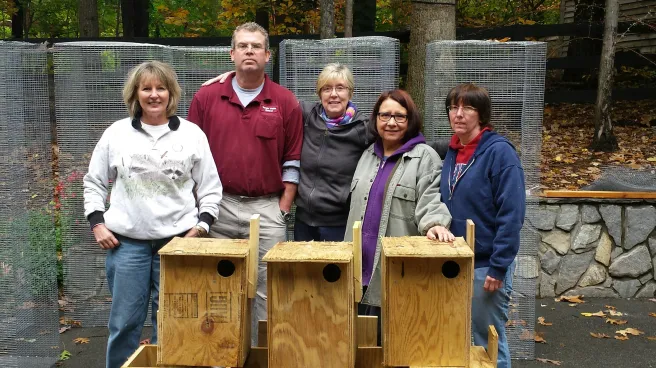
Ask Tad about his approach and the first thing he’ll tell you is that this work isn’t about getting rid of animals. It’s about solving problems in a way that’s fair to both the homeowner and the wildlife. He calls it being a “steward for wildlife,” and that philosophy runs through everything the company does.
Habitat modification and education come first. Tad would rather teach a homeowner how to make their property less attractive to raccoons than trap one every season. But when removal is necessary, it doesn’t automatically mean the animal is destroyed. The goal is always legal, humane removal from the property. Most wildlife that needs to be physically removed is relocated many miles from where it was trapped. Live traps are the standard method, and traps are checked every 24 hours. If a nursing female is caught, Tad’s team has the option to release her, let her raise the young, and remove all of them later rather than separate a mother from her pups.
That philosophy is why Wildlife Welfare, Inc., a 501(c)(3) nonprofit wildlife rehabilitation organization in Apex, NC, exclusively endorses Triangle Wildlife Removal. They’re the only wildlife removal company Wildlife Welfare recommends, and the relationship goes both ways. Whenever Tad’s team encounters orphaned or injured wildlife on a job, they get the animal to a licensed rehabilitator. The company donates supplies, provides transportation, and helps build cages for animals in rehab. A couple of employees are licensed wildlife rehabilitators themselves, and Tad sits on the board of directors of the local Wildlife Welfare branch.
Why He Still Answers the Phone
After 36 years, Tad still personally answers the phone lines. He enjoys it. He has customers who have been calling him for decades, and that continuity matters to him. When someone calls Triangle Wildlife Removal, there’s a good chance they’re talking to the owner, the same person who started this company from a stack of business cards and a truck in 1990.
That’s not a marketing gimmick. That’s how the business was built, and it’s how it still runs.
Credentials at a Glance
- B.S. in Fisheries and Wildlife Management, NC State University (1990)
- Wildlife Management Studies, Unity College, Unity, Maine (1985, transferred to NC State)
- NC Wildlife Control Agent Permit #DCA25000312
- NC Pest Control License #1778 PW
- On-Staff Wildlife Biologist
- National Wildlife Control Operators Association (NWCOA) Member
- Former NC Wildlife Resources Commission Technician (1984-1985, Edenton, NC)
- Former Maine Inland Fisheries and Wildlife Research Intern (1984-1985)
- Former UPS Management (1985-1995, 110 employees, 15 supervisors)
- 36 Years in Wildlife Management (30 Years Full-Time, since January 1, 1996)
- Wildlife Welfare, Inc. Board of Directors Member
- Exclusively Endorsed by Wildlife Welfare, Inc.
- BBB A+ Rating with Zero Complaints
- $5 Million General Liability / $1 Million Workers Comp / $1 Million Auto
- Largest Ridge Guard Installer on the East Coast
- Limited Lifetime Warranty on All Exclusion Work
- Featured Expert in Regency Park Partnership Community Interview
Trusted by the Triangle’s Biggest Names
- NC Wildlife Resources Commission
- NC Department of Transportation (nearly 25 years)
- Wake County Public Schools (20+ year contract)
- Raleigh Housing Authority
- NC State University
- Duke University
- Shaw University
- RDU International Airport
- UNC Hospital Systems
- Office of the NC Governor
- NC Secretary of State
When you call Triangle Wildlife Removal, you’re not getting a call center or a franchise reading from a script. You’re getting a team led by a Wildlife Biologist with 36 years of experience who built this company one referral at a time. If you have a wildlife problem in the Triangle area of North Carolina, give Tad a call. There’s a good chance he’ll be the one who picks up.
Call (919) 661-0722 | Available 7 days a week, 7 AM – 5 PM | 24/7 Emergency Service
Tad Bassett’s Facebook – https://www.facebook.com/tad.bassett.2025/
Tad Bassett’s Instagram – https://www.instagram.com/crittergitter2/
Tad Bassett LinkedIn – https://www.linkedin.com/in/tad-bassett-6b80413b0/