

Call Now For Help With Flying Squirrels
Flying Squirrels in North Carolina: Species, Behavior, and Attic Intrusions
North Carolina is home to two species of flying squirrel: the southern flying squirrel (Glaucomys volans) and the Carolina northern flying squirrel (Glaucomys sabrinus coloratus). The southern flying squirrel is abundant statewide and ranks as the most common mammal most people in North Carolina have never seen. The Carolina northern flying squirrel is federally listed as endangered and restricted to high-elevation spruce-fir forests in the western mountains. Both species are classified as nongame with no hunting or trapping seasons.
When homeowners call about flying squirrels, they are almost always dealing with the southern species. It thrives in the hardwood and mixed pine-hardwood forests that cover most of the Piedmont and Coastal Plain, and it has adapted well to suburban neighborhoods where mature oaks, hickories, and other hardwoods provide food and launch points for gliding. The problem starts when they move from the trees into the attic, which they do readily, especially during the cold months. Because they are nocturnal and colonial, a flying squirrel infestation can go unnoticed for weeks or months before the homeowner realizes there are a dozen or more animals living overhead.
Biology and Physical Characteristics
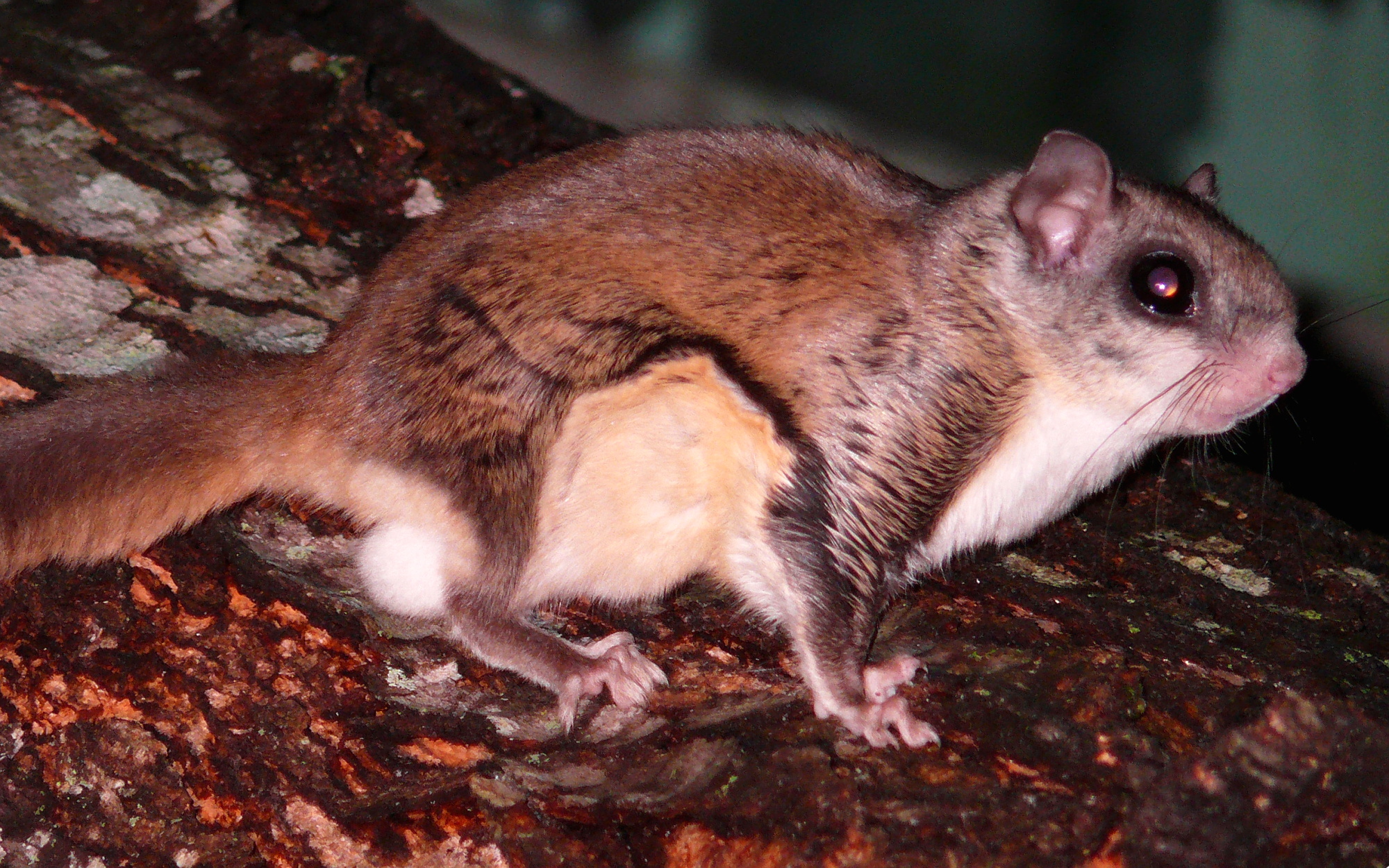
The southern flying squirrel is the smallest of North Carolina’s five tree squirrel species. Adults weigh 2 to 3 ounces – roughly the weight of a deck of playing cards – and measure 8.5 to 10 inches from nose to tail tip, with the tail accounting for 3 to 4 inches of that length. Their fur is soft and silky, light brown to olive-gray on top with a creamy white belly. The hairs on the underside are white all the way to the base, which is one way biologists distinguish them from the northern species, where the belly hairs are gray at the base and white at the tip.
The defining physical feature is the patagium, a furred membrane of skin that stretches from the wrist of the front leg to the ankle of the hind leg on each side. When the squirrel leaps from a high point and extends all four limbs, the patagium stretches into a flat, square-shaped surface that allows it to glide. They do not fly. They glide downward at angles of 30 to 40 degrees, steering with their broad, flat tail and adjusting tension on the membrane to maneuver around obstacles. Glides of 50 meters are common, and the longest documented glide for a southern flying squirrel was 80 meters. Just before landing, they raise the tail sharply to create a parachute effect, flare upward, and absorb the impact with all four limbs against the trunk of the target tree.
Their eyes are disproportionately large relative to their head – an adaptation for nocturnal vision. They also have prominent ears and long whiskers, both of which aid navigation in low-light conditions. On the ground they are clumsy and slow, preferring to hide rather than run if threatened. In the air and on tree trunks, they are fast and agile.
Southern flying squirrels can live up to 10 years under ideal conditions, but most wild individuals survive no more than 5 years. Predators include owls (particularly screech owls and barred owls), hawks, rat snakes, raccoons, and domestic cats.
Reproduction and Young
Southern flying squirrels breed twice per year. The first breeding period runs from February through March, with litters born between early March and mid-April. The second occurs from May through July, producing litters from July through September. Gestation lasts approximately 40 days. Average litter size is 3 to 4 pups, though litters can range from 1 to 7.
Pups are born blind, hairless, and completely dependent on the mother. They weigh 3 to 5 grams at birth – less than a quarter of an ounce. Their ears open at about three weeks, and their eyes open at four weeks. Weaning begins around five to six weeks, and by eight weeks the young are fully furred, nearly adult-sized, and capable of gliding. Young typically stay with the mother until her next litter is born.
Males leave the female before the pups arrive and provide no parental care. Females are fiercely territorial around the nest during the rearing period and will move the entire litter to a new nest site if they feel threatened or if parasite loads build up in the current den. This maternal relocation behavior is relevant to removal situations – disturbing a nesting female can cause her to scatter pups into wall voids and other areas of the structure that are harder to access.
Female offspring born during the summer breeding season typically reach sexual maturity and breed by the following spring. Most females continue reproducing through each breeding season until about three years of age.
Seasonal Behavior and Habitat
Southern flying squirrels do not hibernate. They remain active year-round, though their behavior shifts significantly with the seasons. In warmer months, they are dispersed across their home range, nesting in tree cavities, old woodpecker holes, and leaf nests. Home ranges average about one acre for females and 1.5 acres for males.
As temperatures drop in late fall and winter, flying squirrels become increasingly colonial. They aggregate in shared dens to conserve body heat, and these winter congregations can be surprisingly large. Groups of 10 to 15 are common, and aggregations of up to 19 or even 25 individuals sharing a single den have been documented. This communal nesting behavior is the main reason attic infestations involve multiple animals. A homeowner hearing scratching and running in the ceiling during December or January is rarely dealing with a single squirrel.
Their natural habitat is hardwood and mixed pine-hardwood forest, and they require older trees with cavities for denning. In suburban settings, mature oak and hickory trees in yards and along streets provide both food (acorns are a primary food source) and launching platforms for gliding to rooftops. A neighborhood with 40- or 50-year-old hardwoods and houses built in the same era – aging rooflines with original trim and settling gaps – creates ideal conditions for flying squirrel intrusion.
Flying squirrels are strictly nocturnal. They emerge from dens at dusk and forage through the night, returning before dawn. During winter, they may remain in the den for several consecutive days during severe cold, but they do not enter a dormant state.
Why Flying Squirrels Become a Nuisance
The NCWRC notes that flying squirrels in attics “can make quite a racket” but “don’t generally pose any significant problems for the homes they occupy.” That assessment is accurate for a short-term, small-scale presence. The situation changes when a colony of 10 to 20 animals has been nesting in an attic for months or longer.
The noise is usually what gets a homeowner’s attention first. Flying squirrels are active from dusk through the predawn hours, which puts their peak activity – running, gliding to and from the structure, vocalizing, gnawing, and shuffling through insulation – right in the middle of the homeowner’s sleep cycle. They produce a high-pitched birdlike chirping and a rapid trilling sound. Some of their vocalizations are ultrasonic and inaudible to humans, but plenty of their communication falls within the range of hearing, especially the squeaks and chattering that occur inside wall cavities and attic spaces where sound carries into the rooms below.
Structural damage from flying squirrels is generally less severe than what gray squirrels inflict, but it is not negligible. They gnaw on wood trim, wiring insulation, and stored items. They soil insulation with urine and droppings. Food caches of acorns and other nuts hidden in insulation, wall voids, and eaves attract secondary pests including beetles, moths, and mice. Over time, a colony’s combined droppings, urine, and cached food create odor problems and insulation degradation.
The colonial nature of the animal amplifies every problem. Where a single gray squirrel might cause localized damage at one entry point and one nesting area, a colony of flying squirrels spreads waste and activity across a broader area of the attic. Their small body size also means they can access areas that larger squirrels cannot – dropping into wall voids from the attic, running along plumbing chases, and occasionally ending up inside the living space.
Health Risks Associated with Flying Squirrels
Sylvatic typhus. The most distinctive health risk associated with southern flying squirrels is sylvatic epidemic typhus, caused by the bacterium Rickettsia prowazekii. This is the same organism responsible for classic epidemic typhus (historically spread by body lice), but in the United States, the CDC identifies flying squirrels and their nests as the source of sporadic cases. The disease is transmitted to humans through the feces of fleas and lice that parasitize the squirrels. When those droppings become airborne – which happens easily in an enclosed attic or wall void – people can inhale the contaminated material and become infected.
Sylvatic typhus is rare. The CDC documented 41 cases in the United States between 1976 and 2002. A CDC investigation of a cluster in Pennsylvania found that all infected individuals had slept in a cabin with flying squirrels nesting in the adjacent wall, and 71% of the flying squirrels trapped at the site tested positive for R. prowazekii. Symptoms include fever, severe headache, muscle pain, chills, and sometimes rash. It is treatable with antibiotics (doxycycline) when caught early, but it can be serious if misdiagnosed or untreated. The rarity of the disease means many physicians do not consider it in their initial differential diagnosis.
The practical takeaway is that removing flying squirrels from a structure without also addressing the ectoparasites they leave behind – fleas, lice, and mites – can actually increase risk to the occupants. Once the host animals are gone, parasites that remain in the nesting material will seek alternative hosts, including humans. Pest control treatment of the nesting areas should be part of any flying squirrel removal.
Leptospirosis. Like most rodents, southern flying squirrels can carry Leptospira bacteria in their urine. Contact with urine-contaminated insulation or surfaces in an attic poses a potential exposure risk, particularly through broken skin or mucous membranes.
Salmonella. Flying squirrel droppings can harbor Salmonella bacteria, a concern when fecal material accumulates in an enclosed space and is disturbed during cleanup or renovation work.
Ectoparasites. Beyond the typhus risk, the fleas and mites associated with flying squirrel colonies are a standalone nuisance. When squirrels are excluded from an attic without treating the nesting material, these parasites migrate downward into living spaces seeking new hosts. The result is flea or mite infestations in bedrooms and living areas that seem to appear out of nowhere, often weeks after the squirrels are gone.
Sylvatic Typhus: The Flying Squirrel Disease
Sylvatic typhus deserves a closer look because it is a health risk unique to flying squirrel infestations. No other common attic-dwelling wildlife species in North Carolina carries Rickettsia prowazekii.
The bacterium circulates in a cycle between flying squirrels and their ectoparasites, primarily fleas (Orchopeas howardi) and sucking lice (Neohaematopinus sciuropteri). The squirrels themselves can carry the bacteria without showing obvious signs of illness. Transmission to humans is believed to occur when flea or louse feces contaminated with R. prowazekii become aerosolized and are inhaled, or when contaminated material contacts broken skin or mucous membranes.
Nearly all documented cases in the United States have occurred during the cold months – November through March – which aligns with the period when flying squirrels aggregate in communal winter dens inside buildings and their ectoparasite loads are concentrated.
The disease is curable with doxycycline when caught early, but delayed treatment can lead to kidney damage, neurological effects, and in rare cases, death. The challenge is recognition. A doctor who is not aware of a flying squirrel infestation in the patient’s home may not consider typhus, since the disease is so uncommon. If flying squirrels have been living in your attic, mention it to your physician if you develop an unexplained fever, particularly during winter.
Legal Status and Regulations in North Carolina
The southern flying squirrel is classified as a nongame species in North Carolina with no open hunting or trapping season. The Carolina northern flying squirrel is federally and state-listed as endangered and is fully protected. However, the northern species is found only at elevations above 4,000 to 5,000 feet in the western mountains and does not enter residential structures in the Piedmont or Coastal Plain. Any flying squirrel in an attic in the Triangle region, the Sandhills, or the eastern part of the state is a southern flying squirrel.
Homeowners in North Carolina do not need a permit to trap an animal on their own property. However, a permit from the NC Wildlife Resources Commission is required to remove a trapped animal from the property. Any person or company performing wildlife removal for compensation must hold a valid Wildlife Control Agent (WCA) license issued by the NCWRC. Employees working under a licensed WCA must carry a separate Wildlife Control Technician (WCT) license. Both licenses are renewed annually and expire on December 31.
There is no seasonal moratorium on flying squirrel removal equivalent to the May 1 through July 31 bat eviction prohibition. Flying squirrels can be excluded from structures year-round. The preferred legal method is exclusion – sealing all entry points except the primary opening, installing a one-way device at that opening to allow the squirrels to leave but not return, and then sealing the final entry point once the animals have vacated.
Common Entry Points on Structures
Flying squirrels need very small openings. Their body size – roughly equivalent to a large mouse when they flatten against a surface – allows them to squeeze through gaps that homeowners would never suspect as entry points.
Soffit-to-fascia junction. The intersection where the soffit panel meets the fascia board is the single most common entry point for flying squirrels. Settling, wood rot, and seasonal expansion and contraction of materials open gaps at this junction that the squirrels exploit readily.
Construction gaps at the roofline. Where roof sheathing meets the top plate of the exterior wall, builders often leave small gaps that are concealed by trim and flashing. These builder gaps are invisible from the ground but provide a direct path into the attic.
Ridge vents. The vent running along the peak of the roof is designed to allow airflow but keep animals out. Factory screens deteriorate over time, and gaps where sections of ridge cap meet are common points of entry.
Gable vents. The louvered or screened vents in the gable ends of the attic. Aluminum or fiberglass screening behind the louvers degrades, and flying squirrels can gnaw through weakened screen material.
Utility penetrations. Gaps around HVAC line sets, plumbing vents, and electrical conduits that pass through exterior walls are often left unsealed or sealed with materials that shrink and pull away over time.
Because flying squirrels are gliders, they do not need to climb the exterior wall to reach these entry points. They launch from a nearby tree, glide to the roofline, and enter from above. This means that entry points near the peak of the roof – ridge vents, upper gable vents, dormer joints – are just as accessible to them as lower entry points are to climbing species like gray squirrels and raccoons.
Signs of Flying Squirrel Activity
The most reliable early sign is sound. Flying squirrels are active at night, so scratching, scurrying, and soft thumping noises coming from the attic or walls between dusk and dawn are the classic indicators. The sounds are lighter and faster than what gray squirrels produce – more of a rapid scurrying than heavy thumping. The high-pitched chirping and trilling vocalizations are distinctive and unlike anything a rat or mouse produces.
Droppings are another indicator, though flying squirrel droppings can be confused with those of other small rodents. They are small, dark, oblong pellets, roughly the size of a grain of rice. The key distinction from mouse droppings is quantity and location. Flying squirrel droppings accumulate near entry points and along travel routes in the attic, often concentrated in areas where the animals enter and exit the structure. Mouse droppings are scattered more broadly and found at ground level. If droppings are appearing in the attic near the roofline, the source is more likely a flying squirrel than a mouse.
Gnaw marks on wood trim, fascia boards, and wiring insulation are another indicator, though these are less dramatic than gray squirrel gnawing. Flying squirrels chew, but they are not as aggressive about enlarging openings as gray squirrels are. They tend to use existing gaps rather than creating new ones.
Food caches are a strong indicator of flying squirrel activity. Piles of acorns, hickory nuts, or other seeds hidden in insulation, tucked into wall voids, or stuffed into gaps around ductwork are characteristic of flying squirrel hoarding behavior. If you find a stash of nuts in your attic insulation, flying squirrels are almost certainly responsible.
Visually confirming the animals requires watching the exterior of the home at dusk. Flying squirrels emerge shortly after sunset. From the right vantage point, you may see them gliding from a nearby tree to the roofline, or emerging from a gap in the soffit or fascia and launching off the building. Their gliding silhouette – a flat, square shape with the tail trailing behind – is unmistakable once you have seen it.
The Role of Flying Squirrels in the Ecosystem
Southern flying squirrels fill an important ecological niche in North Carolina’s hardwood forests. Their diet of fungi – particularly mycorrhizal fungi and truffles – makes them a significant disperser of fungal spores. Mycorrhizal fungi form symbiotic relationships with tree roots, helping trees absorb water and nutrients from the soil. By eating these fungi and depositing spores in their droppings across the forest floor, flying squirrels contribute directly to forest health and tree regeneration.
Their prolific nut caching also contributes to seed dispersal. Not every cached acorn or hickory nut gets retrieved. Forgotten caches germinate and produce new trees, making flying squirrels an active if unintentional participant in forest regeneration.
As prey, they are an important food source for owls, hawks, snakes, and other predators. Their nocturnal activity pattern makes them especially important for nocturnal predators like screech owls and barred owls, which depend on them as a primary prey species in many forested areas.
The U.S. Fish and Wildlife Service’s recovery efforts for the endangered Carolina northern flying squirrel in the western mountains reflect how seriously the conservation community takes these animals. Even the abundant southern species plays a role worth respecting.
A flying squirrel gliding between oaks in your backyard is doing its job – dispersing spores, caching seeds, feeding owls. The problem is strictly about location. Inside your attic, those same behaviors produce noise, contamination, structural soiling, and disease risk. Proper exclusion solves the building problem without eliminating the animal from the environment where it belongs.