

Call Now For Help With Opossums
Opossums in North Carolina: Behavior, Benefits, and Property Conflicts
The Virginia opossum (Didelphis virginiana) is the only marsupial native to North America and is found throughout North Carolina in all three regions of the state – Mountains, Piedmont, and Coastal Plain. It was designated as North Carolina’s official state marsupial in 2013. The NC Wildlife Resources Commission classifies it as a game species and furbearer with regulated hunting and trapping seasons.
Opossums are among the most misunderstood animals in the state. Their unusual appearance – pointed snout, hairless ears and tail, hissing and drooling when threatened – leads many people to assume they are aggressive, diseased, or dangerous. In reality, opossums are slow-moving, non-confrontational animals that provide significant pest control benefits. They are one of the least likely mammals in North Carolina to carry rabies. They eat ticks, cockroaches, rats, mice, snakes (including venomous species), slugs, snails, and carrion. That said, they do become a nuisance when they take up residence under decks, in crawlspaces, inside garages, or beneath buildings where their presence creates odor, mess, and occasional property damage.
Biology and Physical Characteristics
The Virginia opossum is roughly the size of a large house cat, measuring 13 to 22 inches from snout to the base of the tail, with the tail adding another 10 to 21 inches. Adults weigh 4 to 14 pounds, with males slightly larger than females. The fur ranges from light gray to nearly black, with most individuals showing lighter underfur overlaid with darker guard hairs. The face is white with dark eyes and black, hairless ears.
The tail is long, scaly, and prehensile – capable of grasping branches and objects, though it cannot support the animal’s full weight as commonly believed. Each foot has five digits. The hind feet have an opposable first toe that functions like a thumb, giving the opossum a strong grip for climbing. Their front feet have long curved claws suited for digging.
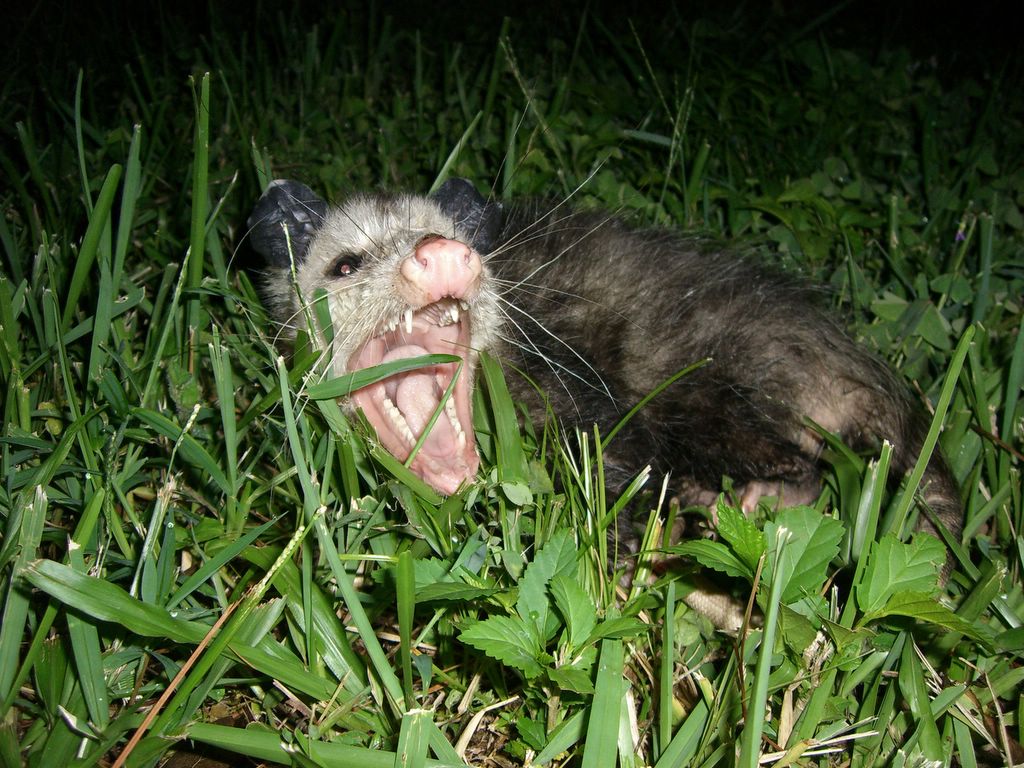
The opossum has 50 teeth – more than any other North American mammal. Despite this intimidating dental count, their bite force is relatively weak and they rarely bite. Their primary defense is the well-known “playing possum” response: when grabbed or severely stressed, the animal enters an involuntary catatonic state, falling limp with its mouth open, tongue out, and eyes glazed while emitting a foul-smelling secretion from anal glands. This state can last from a few minutes to several hours.
Before reaching that point, a threatened opossum will typically face the threat with its mouth wide open, hissing and drooling. This threat display is alarming to look at but is almost entirely bluff. The opossum is trying to appear sick or dangerous precisely because it is not actually equipped to fight.
Opossums have remarkably short lifespans for a mammal their size. Most wild individuals live only 1 to 2 years. Their low body temperature (around 94-97 degrees Fahrenheit, compared to roughly 101 in most placental mammals) is one of the factors that makes them highly resistant to rabies, as the virus does not replicate well at that temperature.
Reproduction and Young
As a marsupial, the opossum’s reproductive biology is fundamentally different from that of placental mammals. After a gestation period of only 12 to 13 days – one of the shortest of any mammal – females give birth to extremely underdeveloped young. Newborn opossums weigh about 0.13 grams (roughly the weight of a honeybee) and must immediately crawl into the mother’s pouch to attach to a nipple and continue developing. A female has 13 nipples, and only the young that successfully attach to one will survive. Litters can number up to 15, but typically only 4 to 7 survive the pouch phase.
The young remain in the pouch for approximately 55 days, then begin emerging for short periods. By about 70 to 80 days they ride on the mother’s back as she forages. They are weaned and disperse on their own at roughly 100 days old. Females may produce up to two litters per year in North Carolina, typically in late winter/early spring and again in late spring/early summer.
Finding a litter of baby opossums – either in a pouch on a dead female found on the road or as a group of young that have dispersed prematurely – is not uncommon. These situations should be directed to a licensed wildlife rehabilitator rather than handled personally.
Seasonal Behavior and Habitat
Opossums are primarily nocturnal and solitary. They do not hibernate and remain active year-round in North Carolina, though their activity may decrease during the coldest winter weeks. Seeing an opossum during the day is not, by itself, a sign of illness – nursing females, dispersing juveniles, and disturbed animals all have legitimate reasons for daytime activity.
They prefer deciduous woodlands near water sources – creeks, streams, ponds, and marshes – but adapt readily to suburban and urban environments. Unlike most territorial mammals, opossums are nomadic. They rarely sleep in the same location twice, wandering nightly through a home range of roughly 10 to 50 acres in search of food and temporary shelter. Dens are typically found in hollow trees, brush piles, rock crevices, abandoned burrows, and under buildings. They do not dig their own dens. They use whatever sheltered space they find, which is why crawlspaces, decks with openings underneath, sheds, and garage floors become temporary opossum dens in residential areas.
Their diet is extraordinarily broad. The NC Wildlife Federation describes opossums as “nature’s vacuum cleaners,” feeding on cockroaches, beetles, worms, snails, slugs, mice, rats, snakes, moles, shrews, fruit, vegetation, carrion, and garbage. They are resistant to the venom of North Carolina’s pit vipers and are known to eat copperheads, cottonmouths, and rattlesnakes with minimal risk. They also consume large numbers of ticks – a frequently cited ecological benefit.
Why Opossums Become a Nuisance
Opossums are the least destructive of the common nuisance wildlife species in North Carolina. They do not gnaw on wiring or building materials like rodents and squirrels. They do not tear open soffits and fascia boards like raccoons. Their impact is more about presence, odor, and mess than structural damage.
Denning under structures. Crawlspaces, porches, decks, sheds, and stoops with openings at ground level are the most common locations for opossum conflicts. The animal finds an accessible space, dens for a night or a few days, and moves on. The problem arises when multiple opossums cycle through the same harborage site, leaving behind droppings and the lingering odor of their anal gland secretions.
Garbage and pet food. Opossums are attracted to unsecured garbage, compost piles, outdoor pet food bowls, and fallen fruit. A homeowner who feeds pets outdoors and leaves food bowls on the porch overnight will eventually attract opossums (and raccoons, and rats).
Dead animal odor. Because of their short lifespan and vulnerability to vehicles, opossums die frequently in and around structures. A dead opossum under a deck or in a crawlspace produces a strong decomposition odor that can persist for weeks.
Chicken coops. Opossums will enter unsecured chicken coops to eat eggs and occasionally kill poultry. The NCWRC recommends a predator-proof coop and run, with feed stored in hard plastic or metal containers with tight-fitting lids.
Droppings. Opossum feces are variable in appearance depending on diet but are generally large, dark, and irregularly shaped. They deposit droppings along travel routes and in den areas, which can contaminate crawlspaces and under-deck areas over time.
Health Considerations
Rabies resistance. The single most important health fact about opossums is that they are highly resistant to rabies. Their low body temperature (94-97 degrees F) makes it difficult for the rabies virus to survive and replicate. While no mammal is completely immune, rabies in opossums is extremely rare. The NCWRC and NC Wildlife Federation both emphasize that an opossum hissing and drooling is exhibiting normal defensive behavior, not symptoms of rabies.
Leptospirosis. Like most wildlife that dens near human activity, opossums can carry Leptospira bacteria in their urine. Contact with contaminated water, soil, or surfaces where opossums have urinated poses an exposure risk, particularly for pets.
Tuberculosis and tularemia. Opossums can carry the organisms responsible for these diseases, though transmission to humans is uncommon in residential settings.
Fleas and ticks. Opossums carry ectoparasites including fleas, ticks, and mites. When opossums den under a structure, their parasites can migrate into the crawlspace and potentially into the living area above. Flea infestations associated with opossum denning sites are not uncommon.
Equine Protozoal Myeloencephalitis (EPM). Opossums are the definitive host for Sarcocystis neurona, the parasite that causes EPM in horses. Horse owners in North Carolina should be aware that opossums defecating near pastures, feed storage, or water sources create an exposure risk for their animals. This is not a human health concern but is significant for equine operations.
The Tick Myth – and the Reality
Opossums have been widely credited with consuming up to 5,000 ticks per season based on a 2009 study that estimated tick consumption in a laboratory setting. This figure has been repeated extensively in popular media and conservation messaging. More recent research has questioned whether the laboratory estimates translate to real-world consumption at those levels, and the scientific consensus is less definitive than the popular narrative suggests.
What is not disputed is that opossums do eat ticks. They are meticulous groomers, and ticks that attach to an opossum during its nocturnal foraging are frequently consumed during grooming. Whether the exact number is 5,000 or significantly fewer, opossums contribute to tick reduction in the areas they frequent. This ecological benefit is worth considering before reflexively removing an opossum that is simply passing through a yard.
Legal Status and Regulations in North Carolina
The Virginia opossum is classified as a game species and furbearer in North Carolina with regulated hunting and trapping seasons. Opossums can be hunted year-round and trapped during the regulated trapping season (October 1 through the end of February).
Homeowners dealing with an opossum on their property can use habitat modification and exclusion as first-line approaches. Securing garbage, removing outdoor pet food, closing off access points under decks and porches, and eliminating ground-level harborage generally resolves opossum conflicts without trapping.
When trapping is necessary, a licensed Wildlife Control Agent (WCA) can be hired for on-site assistance. Unlike raccoons and skunks, opossums are not classified as a rabies vector species, which means they can be relocated. However, relocation must be onto private property with the landowner’s permission. Given the opossum’s nomadic nature and short lifespan, simply closing off the access point that allowed it under the structure is often the more practical and permanent solution.
Signs of Opossum Activity
Tracks. Opossum tracks are distinctive. The hind foot print resembles a small hand with the opposable first toe (the “thumb”) splaying out at nearly a right angle to the other four toes. Front prints show five toes with visible claw marks. These tracks are easily distinguished from raccoon tracks, which show five long, separated fingers without the splayed thumb.
Droppings. Variable in appearance, often large and dark with a somewhat irregular shape. May contain visible insect parts, seeds, or other dietary evidence. Found along travel paths and in den areas.
Odor. A musty, unpleasant smell near crawlspace openings, under decks, or around outbuildings can indicate an opossum denning site. The smell intensifies if the animal has discharged its anal gland secretions in the area.
Night sightings. Opossums are slow-moving and conspicuous when spotted at night. Their eyes reflect greenish-white in flashlight beams. Their waddling gait and gray-white body are unmistakable.
Disturbed garbage or pet food. Overturned garbage cans and emptied pet food bowls found in the morning are consistent with opossum activity, though raccoons produce the same evidence.
The Role of Opossums in the Ecosystem
The Virginia opossum is a native species that has been part of North Carolina’s ecosystem for millions of years. It is one of the most primitive mammal species on the continent, with a lineage that stretches back to the late Cretaceous period. Its survival through that much evolutionary time speaks to the effectiveness of its generalist strategy.
Ecologically, opossums serve as scavengers, pest controllers, and prey. They clean up carrion that would otherwise attract flies and spread disease. They consume rodents, insects, and venomous snakes. They provide food for coyotes, foxes, great horned owls, and bobcats. Their role as a ground-level omnivore fills a niche that few other North Carolina mammals occupy as broadly.
An opossum passing through your yard at night is doing exactly what it has done for 70 million years – eating whatever it can find and moving on. The conflict arises only when it finds a way under your house and decides to stay for a few days. Closing that access point is usually all it takes to resolve the issue and let the animal continue doing its job somewhere that does not involve your crawlspace.